
Record catalogue language from supplied metadata
Brossard’s municipal library offers local history materials such as books, brochures, newspapers and photographs alongside multilingual collections. The exercise is fictional and intended only to demonstrate digital skills.
Build a mock local-history catalogue without inferring document language from the subject or location. Use invented media and language codes; avoid copying genuine book covers or library records.
Check three synthetic catalogue records
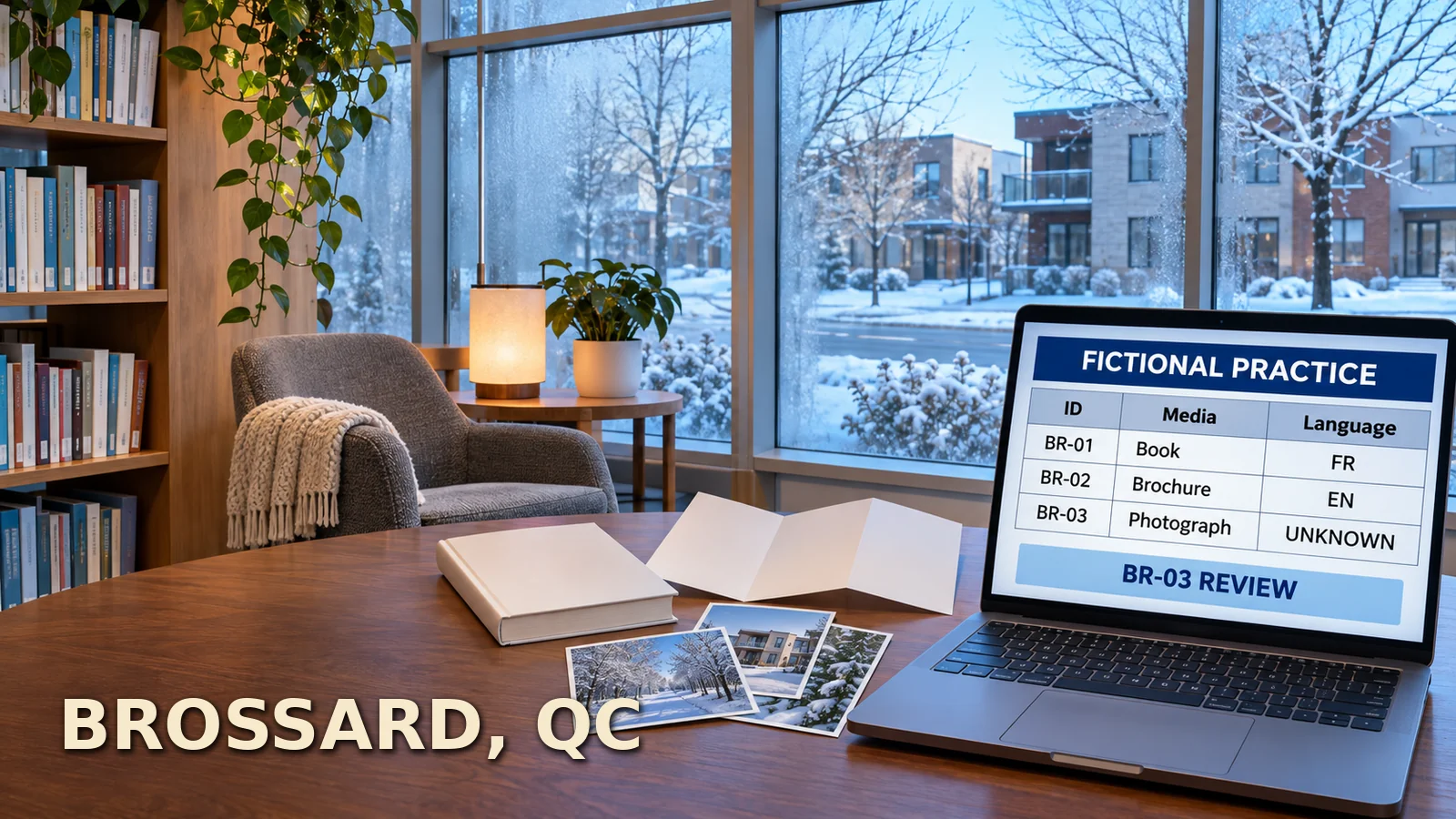
Fictional input: BR-01 book, FR; BR-02 brochure, EN; BR-03 photograph, language not supplied.
Expected output: retain BR-01 book/FR, BR-02 brochure/EN and BR-03 photograph/language unknown. Flag the missing language field for review.
Brossard: a document’s subject is not its language
The municipal Bibliothèque de Brossard describes a local-history collection containing books, pamphlets, newspapers and photographs available in a dedicated consultation room. Its collection page separately lists books in French and English as well as other languages. The library’s locations page identifies the Georgette-Lepage library and its genealogy and local-history room. This local context illustrates why document subject, language, format and access should be recorded separately. A book concerning Quebec is not necessarily written in French.
This guide introduces remote catalogue and document-review skills using fictional records. It is not a library position, a request to process its collections or evidence of a hiring partnership. Check current official Canadian vacancies for actual roles.
Build a fictional register without inferring the document language
Extend the existing mock library exercise with three invented records. BR-04 is a pamphlet on an imaginary town event with language explicitly stated as fr. BR-05 is a newspaper excerpt about the same event with language marked en. BR-06 is a photograph caption about a fictional library with language unspecified. Create fields for item ID, subject, format, supplied language, access status and review note.
Keep BR-04 and BR-05 separate despite their shared subject. For BR-06, retain the missing language field; do not assume it shares the city’s predominant language. If a real role requests language detection, report the inference in a separate review field rather than altering the supplied source. No example refers to actual library materials or patrons.
Handle a bilingual revision without replacing the original
Imagine an invented revision BR-R01 supplies an English translation of BR-04 while retaining its original French text. Keep the original fr record and add the translation as a separate language variant linked to its source. A translation can be supplied without being reviewed; preserve its review status as unknown unless the correction explicitly confirms it. Do not change the language of BR-05 or BR-06.
Check three original item IDs, one translation reference and the unresolved language field. A useful handover distinguishes the language of an original, the language of a derivative and review status. This is private unpaid practice, not a recruitment examination. Use only invented texts, not protected library documents or patron data.
Check equipment, languages and realistic time commitments
Open a mock source card and editable catalogue together. Verify that your keyboard handles accented characters and that the file preserves language codes, identifiers and punctuation after saving. A phone may help browse roles but may not satisfy document-format and detailed review requirements. Confirm the actual vacancy’s Canadian residence, language, schedule, equipment and delivery criteria. Translating this guide does not change a role’s language requirements.
Hire in Global currently requires no recruitment examination or applicant fee. Written post-recruitment terms establish genuine scope, quality, compensation in CAD and payment timing. This example does not guarantee work allocation, a salary or daily income.
Verify offers before disclosing personal information
The Canadian Anti-Fraud Centre warns that false freelance and remote-work offers may misuse the names of actual companies. A familiar Brossard image, library reference or multilingual message is not proof of a genuine employer. Confirm the actual vacancy through the official website. Never pay for work or release of earnings, and never disclose bank access, passwords or verification codes.
If money or account access may be affected, save relevant messages privately, contact your financial institution promptly and report through local police and the Canadian Anti-Fraud Centre. Keep real applicants’ information and confidential employer files outside public practice examples.
Exercise questions in Brossard
Should a photograph automatically receive the catalogue’s default language?
No. Record language only when the relevant field is supplied or verified.
Does recruitment require an advance payment from me?
No. Never pay any recruitment, application, joining or security deposit fee or money to unlock work or earnings.
Is this example a confirmed local job?
No. This locality guide explains remote-work skills through a fictional example. It is not a vacancy announcement or promise of project availability. Consult the official country job listings for current role requirements and eligibility before applying.
Prepare your application
Use invented media and language codes; avoid copying genuine book covers or library records.
Spot recruitment fraud
Apply through the official vacancy. There is no application fee. Never share verification codes or send money to an unexpected contact. Keep suspicious messages as evidence. Report suspected fraud to local police and the Canadian Anti-Fraud Centre; contact your bank or payment provider promptly if you sent money.
Recruitment is free. No application, joining, placement or exam fee. No security deposit. Never pay to obtain work, equipment or release earnings.