
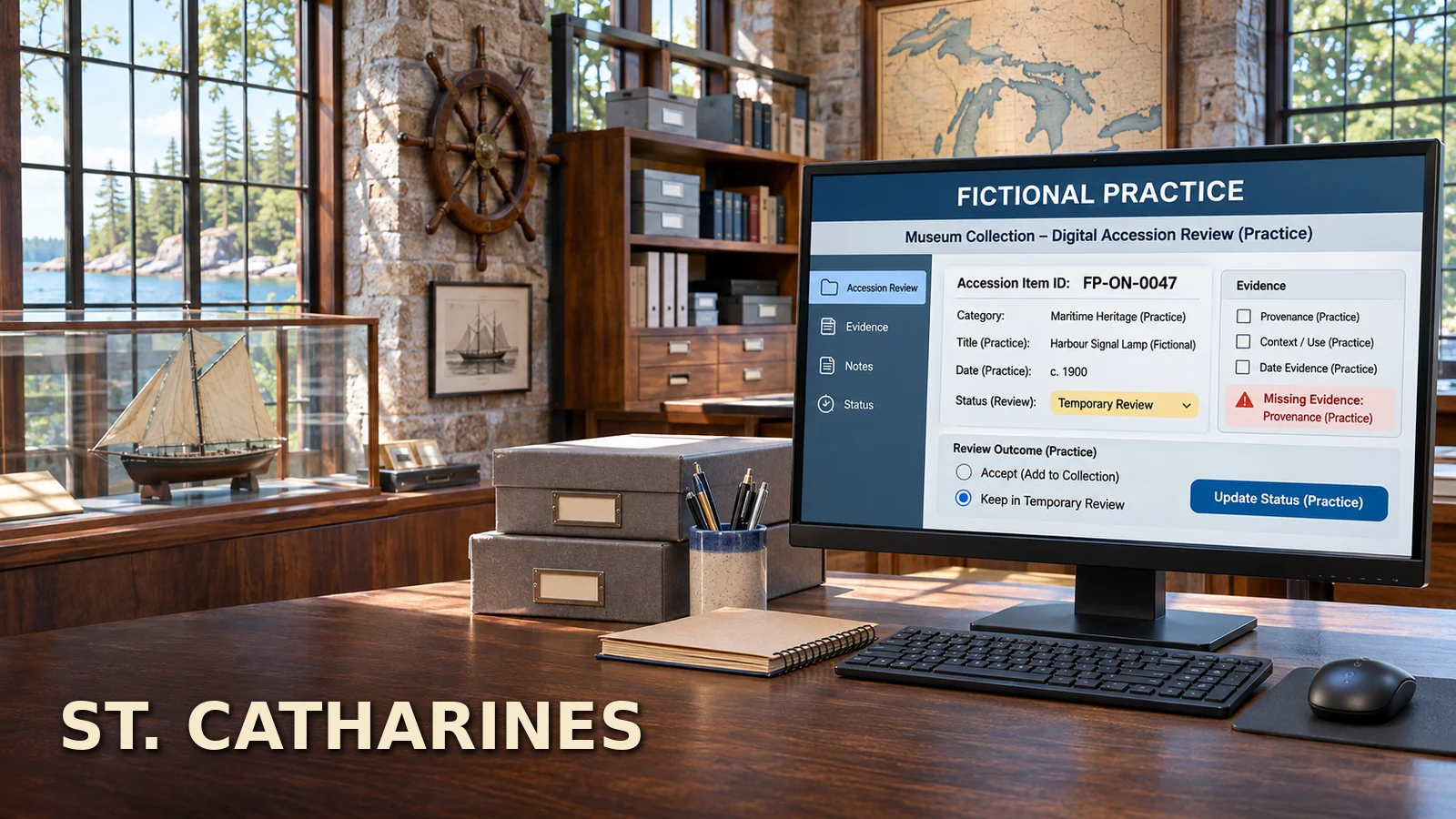
Organise a fictional accession tracker
St. Catharines Museum and Welland Canals Centre preserves photographs, documents and objects linked to the city’s history. The following example is fictional and intended solely to demonstrate digital work skills.
Organise a fictional collection accession tracker with temporary review and confirmed acceptance fields; distinguish absent approval from a duplicate record. Do not imply an actual museum accession, identity, canal operation or permission; use only fictional objects and IDs.
An example accession-review tracker
Fictional SC-01 has temporary review, SC-02 has confirmed acceptance, SC-03 has no approval field; each contains a unique object ID.
Expected output: retain three distinct records and statuses, hold SC-03 for evidence and never assume temporary review is approval.
Museum and canal history inspire media records
The St. Catharines Museum and Welland Canals Centre describes a collection of photographs, objects and archival documents. These media types inspire fictional catalogue records, not museum accession records or an assignment for the institution.
Create three mock media entries
CC-31, drawing of a photo card, image, file P31; CC-32, typed note, text, file T32; CC-33, object sketch, image, file P33. Record subject, media type, file reference and ID separately. All assets are invented for private practice.
Correct a media-type mismatch
Suppose CC-32 is exported as image and linked to P33. Restore text and T32 from its own source. Keep CC-33’s P33 unchanged. The final index contains two images and one text file; reopen each fictional reference and compare its ID in the editable index.
Keep practice separate from recruitment
These invented records are private practice, not a local vacancy, paid project or assignment from a local institution. Consult national listings separately for Canadian location eligibility, language, equipment and any certificate requirements. This example does not guarantee selection or earnings.
Recruitment is free
Hire in Global charges no application, joining, placement or exam fee or security deposit. Never pay to unlock tasks or receive earnings. Verify messages on the official site and report suspected fraud to the Canadian Anti-Fraud Centre.
Practical questions
What type is CC-32?
Text.
Which file belongs to CC-33?
P33.
How many image entries remain?
Two.
Is this a local advertised job?
No, the records are invented for practice.
St. Catharines exercise questions
Is temporary review the same as confirmed acceptance?
No. Preserve those statuses separately and flag missing evidence.
Does recruitment require an advance payment from me?
No. Never send a recruitment, application, joining or security deposit fee or any money to unlock work or earnings.
Is this example a confirmed local job?
No. This locality guide explains remote-work skills through a fictional example. It is not a vacancy announcement or promise of project availability. Consult the official country job listings for current role requirements and eligibility before applying.
Prepare your application
Do not imply an actual museum accession, identity, canal operation or permission; use only fictional objects and IDs.
Spot recruitment fraud
Apply through the official vacancy. There is no application fee. Never share verification codes or send money to an unexpected contact. Keep suspicious messages as evidence. Report suspected fraud to local police and the Canadian Anti-Fraud Centre; contact your bank or payment provider promptly if you sent money.
Recruitment is free. No application, joining, placement or exam fee. No security deposit. Never pay to obtain work, equipment or release earnings.