
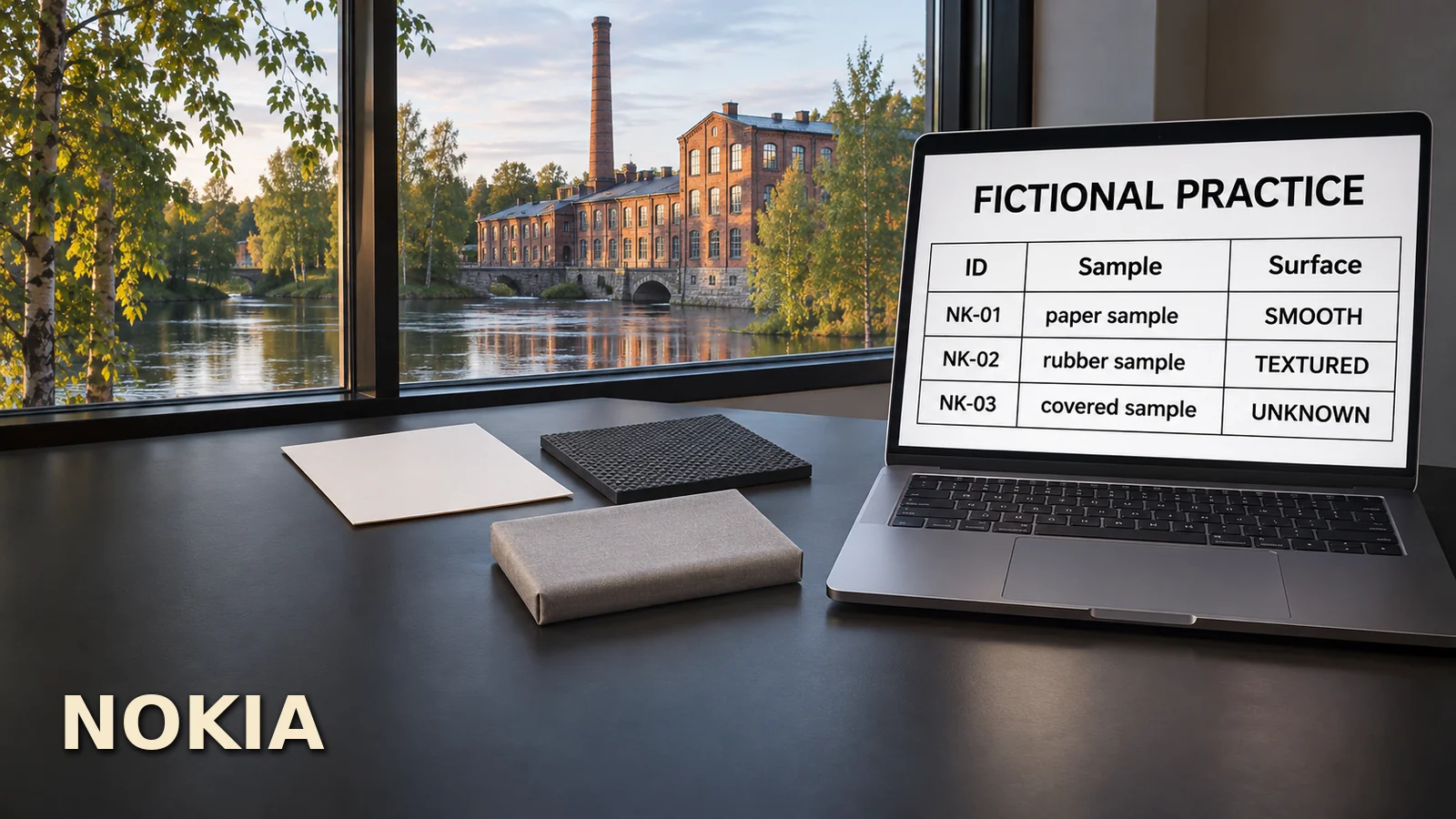
Review material-catalog surface labels
Compare fictional material sample records against explicit surface observations.
Do not infer material from surface or describe production methods or actual workplaces.
Nokia: sample source records
NK-01 paper sample: smooth; NK-02 rubber sample: textured; NK-03 covered sample: surface absent.
Record NK-01 smooth and NK-02 textured; NK-03 surface unknown.
Nokia’s industrial heritage and an information-checking exercise
The city’s historical account describes a pulp mill founded on the north side of the Emäkoski rapids during the 1860s, and the role paper and rubber manufacturing played in subsequent industrial development. Nokia’s museum material also describes how housing developed around the earlier paper industry. These are local historical context only, not claims about today’s employers or vacancies. A fictional material catalogue is a useful way to practise recording supplied evidence while avoiding assumptions about materials and manufacturing. No actual factory, brand, process, product or employer is represented in the following records.
Keep material identity separate from surface observation
Create columns for sample ID, stated material, supplied surface text, and uncertainty. Fictional NK-04 states paper, with “coarse” surface entered; retain both facts without inferring a manufacturing technique. NK-05 gives “glossy” but omits the material field; mark material not supplied. NK-06 identifies rubber, but a cover prevents surface observation; retain the supplied material and label surface unknown. Do not convert “glossy” to a material name or infer hardness, quality, chemical properties, production method or intended use. This distinction makes the output easier to verify because every field has a limited purpose.
Review a change request without rewriting unrelated fields
Imagine the mock instruction changes NK-05’s surface text from “glossy” to “reflective”. Add a revision note and update only that field. The material must remain unknown unless an independent approved source supplies it. Compare the final register with the three original mock cards and count how many fields changed. A useful handover identifies the exact amendment, any unresolved field and the updated version. Use self-created sample records, not confidential technical documents or photos of workplaces. The sample is private practice; it is not a claim about technical expertise, a recruitment exam or paid assigned work.
Identify which remote skills you can realistically offer
For structured records, try a spreadsheet with separate text columns and a consistent missing-value convention. If a role uses document conversion or review rather than spreadsheet entry, confirm its actual file format and tools instead of assuming they are the same. Compare the device and workspace you already have with the vacancy’s actual language, accuracy, availability and residency requirements. Ask whether corrections need a written explanation and how confidential information is handled. A role advertised for a different industry may require qualifications this mock exercise does not demonstrate.
Evaluate an official opportunity rather than an industry association
The city’s industrial history does not imply that any local manufacturer is recruiting through Hire in Global. Use the current Finland role listings to identify actual openings and eligibility, and ask about the written assignment, accuracy calculation, pay currency, amount and schedule after recruitment. The practice register has no promised payment. Recruitment requires no exam fee, application fee, joining fee or deposit. Do not pay a stranger to gain access to an alleged work project. Finnish Police advises contacting your bank immediately if funds or banking access may have been compromised and then reporting the incident; use official contact channels to clarify any doubtful HIG message. Never share banking passwords or verification codes.
Separate different kinds of evidence
A short mock checklist can distinguish descriptive text, supplier-stated material and independently visible characteristics. If a real assignment combines these categories, clarify whether the output requires exact transcription or a reviewed label. The distinction affects how you record uncertainty and which corrections you make. Never change a supplied field merely to make an example look consistent.
Exercise questions for Nokia
Does a covered sample establish a smooth surface?
No, the surface cannot be seen.
Does recruitment require an advance payment from me?
No. Never send a recruitment, application, joining or security deposit fee or any money to unlock work or earnings.
Is this example a confirmed local job?
No. This locality guide explains remote-work skills through a fictional example. It is not a vacancy announcement or promise of project availability. Consult the official country job listings for current role requirements and eligibility before applying.
Recognise recruitment fraud
Apply through the official Hire in Global vacancy page. There is no application fee. Be cautious about unexpected job messages, requests for money and unverifiable invitations. Never share verification codes with an unexpected contact. If safe, retain suspicious messages; do not open suspicious links or attachments. Finland's National Cyber Security Centre at Traficom publishes official guidance about recruitment-related scams.
Never share online banking credentials or approve unexpected authentication. Contact your bank directly if credentials were disclosed; report the matter to police.
Recruitment is free. No application, joining, placement or exam fee. No security deposit. Never pay to obtain work, equipment or release earnings.