
Validate imagined facade-photo reading status
Use written observations from three fictional facade images to check whether their detail fields are readable.
Do not invent the building's use, address, occupants or condition; the image cards are imagined.
Lincoln: sample source records
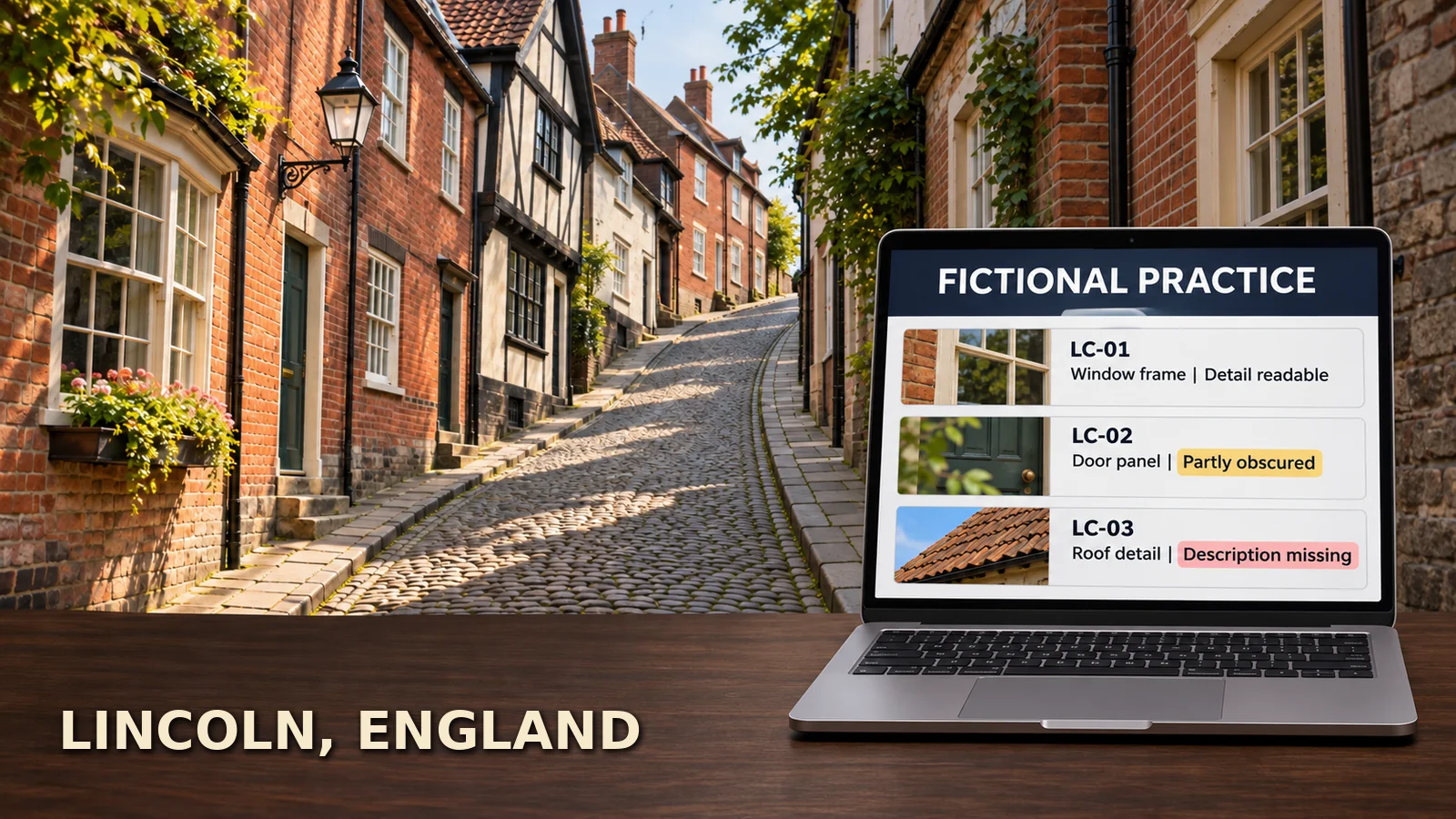
LC-01 window frame, detail readable; LC-02 door panel, detail partly obscured; LC-03 roof detail, descriptive field absent.
Retain LC-01 window frame/detail readable, LC-02 door panel/detail partly obscured and LC-03 roof detail/description missing. Keep descriptive status independent from image quality.
Lincoln's historic quarter and clear descriptions of visual evidence
Visit Lincoln describes the historic Cathedral Quarter and its medieval buildings, including surviving structures on Steep Hill. City of Lincoln Council's conservation information explains that conservation areas cover the historic city centre and other parts of Lincoln. These public local references show why a visual-record reviewer should preserve both what is directly visible and any uncertainty about a description, without inventing facts about a building.
This guide covers Lincoln in England, not other cities with the same name. It is an educational remote-work guide, not a current vacancy at a local heritage organisation or property. The fictional records below contain no actual locations, property identities, access details or condition assessments.
A fictional Lincoln image task: record how much of each text field is readable
Make columns for source ID, supplied visual detail, caption-reading status, supplied text and review note. LN-11 is a facade mockup, detail 'window outline', caption fully readable as 'Sample A'. LN-12 is a facade mockup, detail 'doorway outline', caption partly readable as 'Sam[unclear] B'. LN-13 is a cropped mockup, detail not supplied, caption fully readable as 'Sample C'. LN-14 is an illustration, detail 'roofline', caption unreadable. All four inputs are invented.
Keep the visual-detail and caption-reading fields separate. LN-13 has a readable caption despite lacking a supplied visual detail. LN-14 has a supplied visual detail even though its caption is unreadable. Preserve LN-12's exact partial text instead of completing the word from other examples. No record establishes a real building's identity or current condition.
Prepare a field-specific quality report
The output should contain four unchanged references, three supplied visual-detail labels and one missing visual detail. Its caption statuses should be two fully readable, one partly readable and one unreadable. A record can therefore be complete in one field but unresolved in another. Attach each exception to its source identifier rather than marking every field on the row as missing.
Filter for partly readable or unreadable captions and check that LN-12 and LN-14 appear; LN-13 must not be added to that filter just because another field is missing. Restore the full table, save and reopen the export. This is voluntary unpaid practice, not a recruitment examination or actual heritage review task.
Choose a genuine remote role and suitable equipment from Lincoln
Document conversion, text entry and digital review may involve different quality checks, such as preserving characters, reference labels and source uncertainty in an output. The example gives you a small practice task without needing real property images. Check the current UK listings to determine whether a particular role is available and what skills it requires.
A phone may support checking listings, reading messages or completing supported application steps. Reviewing tiny text, comparing images or editing structured files may call for a laptop or desktop. Check language, hours, location eligibility, software and equipment before accepting actual work.
Check recruitment fees, payment terms and fraud-reporting guidance
The current Hire in Global recruitment process has no application, joining, placement, selection or recruitment-exam fee. Never pay someone to unlock assignments, guarantee selection or release earnings. The UK Government's Stop! Think Fraud campaign warns about false job offers requesting payments for supposed checks or training.
A genuine assignment's written conditions determine the task scope, quality checks, compensation, currency and payment schedule. This locality guide does not guarantee daily work or daily payment. Verify messages through official hiring channels, contact your bank promptly if money or account access is at risk and follow official UK fraud-reporting guidance.
Questions about home-based digital work from Lincoln
Can a record have a readable caption and an unknown visual detail?
Yes. The two fields have independent evidence; keep the supplied value and mark only the missing field.
Should a partial caption be completed from a similar record?
No. Preserve its exact partial text and put the uncertainty in the review note.
Does this fictional exercise establish a Lincoln heritage or conservation job?
No. It provides public local educational context only; actual role listings establish work availability.
Do I need to pay or finish the sample to apply?
No. The exercise is optional and unpaid. Current recruitment has no fee or recruitment exam, and actual eligibility is checked separately.
Exercise questions for Lincoln
Should the absent LC-03 field be marked readable because the image is clear?
No. A missing description must be flagged separately from image quality.
Does recruitment require an advance payment from me?
No. Never send a recruitment, application, joining or security deposit fee or any money to unlock work or earnings.
Is this example a confirmed local job?
No. This locality guide explains remote-work skills through a fictional example. It is not a vacancy announcement or promise of project availability. Consult the official country job listings for current role requirements and eligibility before applying.
Spot recruitment fraud
Apply through the official vacancy page. There is no application fee. Keep evidence of unexpected payment requests or messages from a recruiter impersonator. Never give out verification codes. In England, Wales or Northern Ireland, use Report Fraud; in Scotland, report through Police Scotland.
Recruitment is free. No application, joining, placement or exam fee. No security deposit. Never pay to obtain work, equipment or release earnings.