
Prepare a fictional digital heritage register
The following example is fictional and intended solely to demonstrate digital work skills.
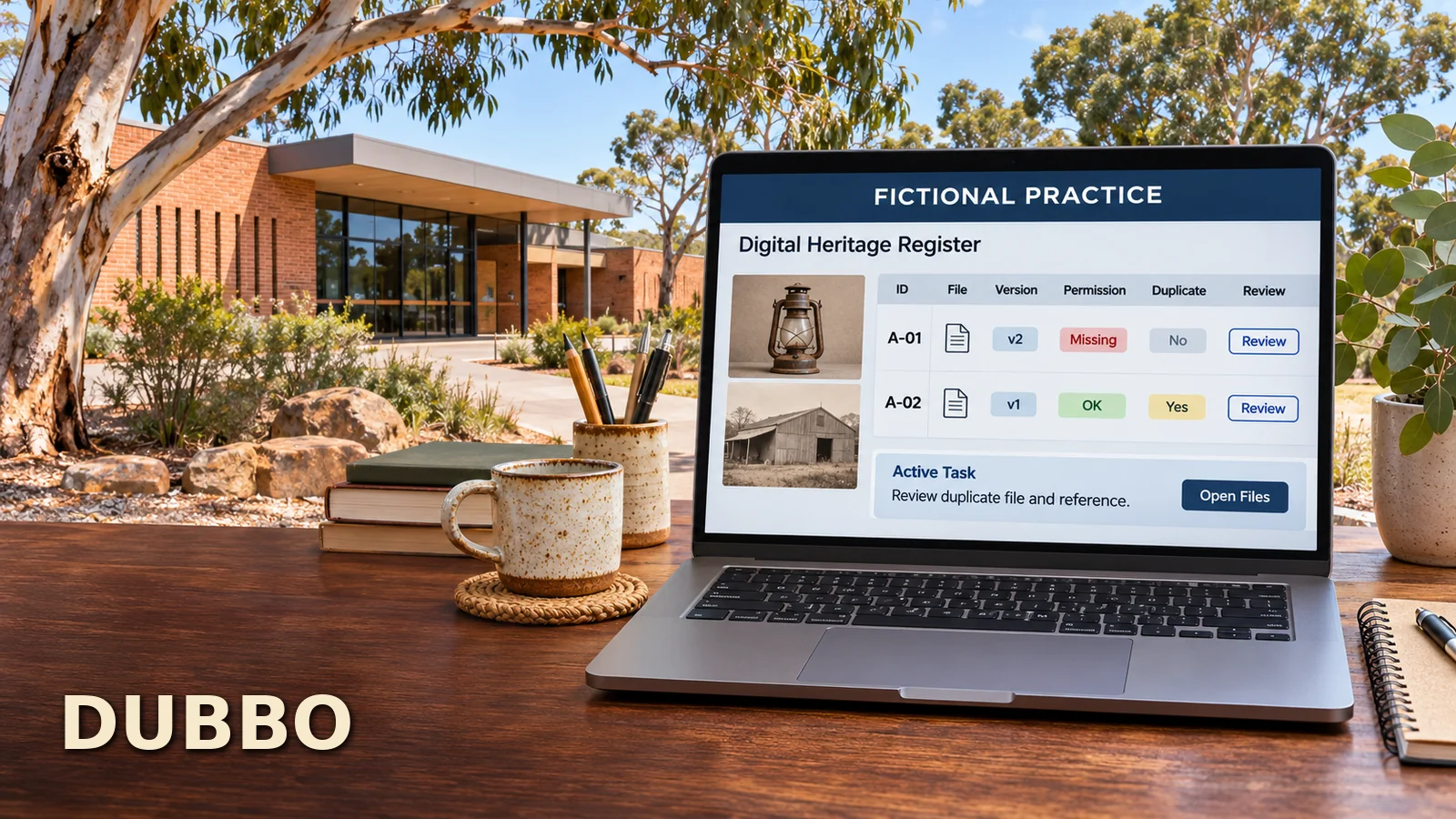
Create a fictional digital heritage register with object reference, supplied caption, file version and missing permission status; identify a duplicate file ID. Use invented identifiers and do not download, reproduce or identify actual museum objects or artists.
An example digital catalogue reference check
Fictional records DU-01 and DU-03 have distinct object IDs but the same file reference F1; DU-02 has a unique F2 and no permission status.
Expected output: flag the duplicate file reference without merging objects and leave DU-02 permission unconfirmed. Retain the original captions and versions.
Keep catalogue identifiers and object descriptions distinct
Dubbo Regional Council reports that its Reveal Collections website contains digital records of the region's heritage and art collections. This public cultural context inspires a synthetic catalogue task, not an instruction to access, download, reproduce or identify actual collection material.
Data management preparation can involve checking unique identifiers, independent versions and source notes. This locality guide teaches a skill, not a currently advertised vacancy.
Create a fictional two-version catalogue
Invent DB-C01 | Paper reading card | Version 01 | Ref A; DB-C02 | Abstract drawing | Version 01 | Ref B; DB-C02 | Abstract drawing | Version 02 | Ref C. These are imaginary records of self-created materials, not museum objects.
Store record ID, title, version, source and review state. Treat ID plus version as the unique key. Do not reuse real collection identifiers, actual artist names or copyrighted art.
Audit the version register
In a practice copy merge both DB-C02 versions and replace DB-C01's Ref A with Ref B. Restore its original reference and both versions of DB-C02 as independent entries. Record the changes in an audit log.
Verify three compound keys, two corrections and two legitimate versions of one fictional item. Preserve original and reviewed catalogues separately. Do not infer actual museum object identity, ownership, collection condition or availability.
Prepare for actual remote work
Students and new applicants can practise version-aware spreadsheet review using their own original paper examples. Consult country listings for actual role availability, tools, equipment, validation needs and eligibility.
This exercise is optional unpaid self-study, not an exam, client work or a promise of selection. Check official Australian country job listings for current availability and eligibility, including location, language, schedule, equipment and written remuneration in AUD, acceptance and payment conditions.
Apply safely using the official vacancy form
Hire in Global conducts no recruitment exam and charges no application, joining, placement or security deposit fee. If eligible, use its official vacancy form; keep your application reference and confirmation email, check spam, and avoid duplicate pending applications.
Never pay for selection, equipment or release of earnings. Keep passwords and OTPs private and verify official contacts independently. Preserve suspicious messages privately; Australia's Scamwatch accepts scam reports. Contact your bank through official channels if financial details may be affected. Local sources do not endorse recruiters.
Dubbo exercise questions
Should two files with the same caption automatically be treated as one catalogue item?
No. Compare the unique file and object references before proposing any merger.
Does recruitment require an advance payment from me?
No. Never send a recruitment, application, joining or security deposit fee or any money to unlock work or earnings.
Is this example a confirmed local job?
No. This locality guide explains remote-work skills through a fictional example. It is not a vacancy announcement or promise of project availability. Consult the official country job listings for current role requirements and eligibility before applying.
Is a repeated record ID automatically a duplicate?
No. Compare the version field too.
Which record has two versions?
DB-C02.
Is this exercise paid?
No. Optional unpaid practice, not a recruitment exam.
Where can I report suspicious recruitment messages?
Use the company’s official Contact page and Australia’s Scamwatch report-a-scam page as appropriate; contact your bank when necessary.
Spot job and recruitment scams
Apply through the official job opening. There is no application fee. Never share verification codes or send money to someone who contacts you unexpectedly. Save evidence and report suspected job scams to Scamwatch.
Recruitment is free. No application, joining, placement or exam fee. No security deposit. Never pay to obtain work, equipment or release earnings.